
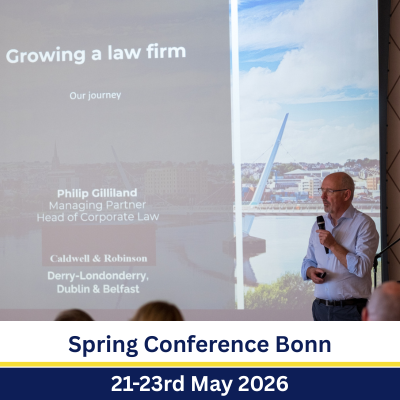
Philip Gilliland speaks to delegates at an Avrio Advocati Conference in Bonn about sustainably growing his law firm Caldwell & Robinson
Philip Gilliland delivered an insightful and deeply personal presentation on the growth, culture and business philosophy of the firm he has built alongside his wife, Karen O’Leary, Senior Partner and Head of Family & Child Law. Reflecting on their journey since joining the Avrio Advocati network in 2009 as a micro law firm, and drawing on decades of experience, he explored the practical realities of building a modern legal practice while preserving strong values and culture.
Philip’s presentation outlined the firm’s transformation into a multi-disciplinary practice operating across both Northern Ireland and the Republic of Ireland, with significant growth achieved in recent years. He spoke openly about the different factors that had shaped that progress, including a desire to remain professionally challenged, a commitment to making a positive contribution within the community, and a belief that law firms need to be run in a sustainable and commercially responsible way.
While financial performance was recognised as an important part of that journey, it was presented as one element within a broader long-term approach to building the business and supporting its people.
Central to the presentation was the firm’s entrepreneurial mindset. Philip encouraged lawyers to think of themselves as entrepreneurs whose product is the provision of legal services. He simplified the operation of the business into three interconnected pillars: sales, production, and finance. He stressed the importance of pursuing areas of work that lawyers genuinely enjoy, building expertise in growth markets, and embracing business development with confidence and honesty.
A significant focus was placed on talent and leadership. Philip highlighted that legal businesses ultimately succeed through people, and that leadership involves nurturing and developing talent rather than simply expecting excellence to emerge naturally. He also reflected on the importance of teaching lawyers to understand the financial realities of running a practice, including the distinction between profit and partner drawings and the need to reinvest in long-term growth.
One of the most engaging aspects of the session centred on organisational culture, which Philip described as the “great enigma” of business success. He argued that a positive and progressive culture directly enhances productivity and trust, while toxic environments can quickly undermine performance. The firm’s experience during the COVID-19 period, when remote working reinforced rather than weakened trust and cohesion, was presented as evidence of the strength of its internal culture.
The presentation also explored practical operational decisions, including the adoption of an open-plan office environment designed to encourage collaboration, mentoring, and knowledge transfer between lawyers at different stages of their careers. Philip acknowledged that such changes required adjustment, but argued that the long-term benefits to productivity and team development had been significant.
During the Q&A session, facilitated by John Clarke, Founder of Woodhaven Consulting and lead of the Avrio Advocati Managing Partner Forum, discussions focused on a range of key issues facing professional services firms today. Topics included the challenges of recruitment outside major metropolitan centres, the importance of cultural alignment in hiring decisions, the potential risks of growth through acquisition, and the strong link between employee satisfaction, workplace culture, and financial performance. Philip also highlighted the importance of adopting strategic and tax-efficient business structures to enable reinvestment and support sustainable long-term growth.
Overall, the session provided delegates with a thoughtful and practical perspective on law firm leadership, emphasising that sustainable growth depends not only on legal expertise, but also on culture, entrepreneurship, financial discipline, and a long-term commitment to developing people.