
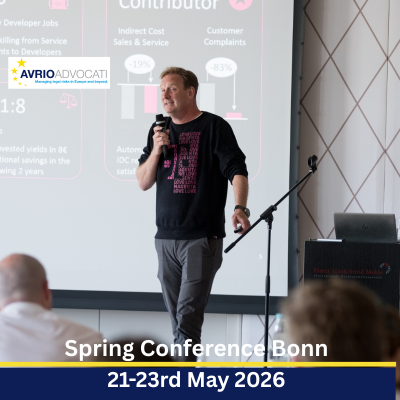
Mr Einacker Addresses Avrio Advocati Spring Conference delegates in Bonn, May 2026
Delegates attending the Avrio Advocati Spring Conference in Bonn were given a fascinating insight into the realities of large-scale digital transformation during a presentation by Marco Marco Einacker, Vice President Service IT DT at Deutsche Telekom.
Drawing on Deutsche Telekom’s experience in automation and artificial intelligence, Marco shared how one of Europe’s leading telecommunications providers is harnessing technology to improve customer service, increase operational efficiency and prepare for an increasingly digital future.
From Automation to Intelligent Services
Marco outlined Deutsche Telekom’s long-term automation journey, which began with traditional robotic process automation (RPA) and has evolved into a sophisticated ecosystem combining automation, artificial intelligence and advanced digital workflows.
Operating at significant scale, Deutsche Telekom manages millions of customer interactions every year. Automation now plays an important role in supporting these operations, enabling the business to handle routine processes more efficiently while improving service quality and consistency.
A key development has been the introduction of generative AI technologies to support the handling of written customer communications. Rather than relying solely on rule-based systems, AI can now interpret customer intent, extract relevant information and help determine the most appropriate course of action. This has led to significant improvements in the automated processing of customer requests while reducing the need for manual intervention.
Marco also explored the emergence of “agentic AI” – systems capable of making decisions within defined parameters and managing increasingly complex workflows. While human oversight remains essential, these technologies are creating new opportunities to streamline processes and improve customer experiences.
Making AI Work in Practice
One of the central themes of the presentation was that successful AI implementation is not simply a technology challenge. Deutsche Telekom’s experience demonstrates the importance of organisational commitment, clear leadership and dedicated resources.
Marco explained that meaningful progress only accelerated once specialist teams were given clear objectives and ownership of AI initiatives. He also highlighted the importance of employee engagement, noting that automation is often most successful when focused on removing repetitive and time-consuming tasks, allowing people to concentrate on higher-value activities.
The presentation provided a practical reminder that digital transformation is as much about people and processes as it is about technology.
The Importance of Digital Sovereignty
Alongside the discussion on AI, Marco addressed the growing significance of digital sovereignty for organisations operating in an increasingly interconnected world.
He described digital sovereignty as the ability of organisations to maintain control over their data, technology infrastructure and operational capabilities. As businesses become increasingly reliant on cloud platforms, software ecosystems and AI services, understanding and managing these dependencies is becoming an important strategic consideration.
The discussion highlighted the need for organisations to balance innovation with resilience, ensuring that technology decisions support long-term flexibility and control while avoiding unnecessary dependency on any single provider.
Lessons for the Legal Profession
For law firms and professional services organisations, the presentation offered a number of valuable takeaways. Successful AI projects begin with clearly defined business objectives, robust governance structures and high-quality data. Equally important is ensuring that new technologies are embedded into core business processes and supported by the people who use them.
Marco’s presentation provided delegates with a pragmatic and balanced perspective on both the opportunities and challenges presented by artificial intelligence. While the technology continues to evolve at pace, the key message was clear: organisations that combine innovation with strong governance, strategic planning and a focus on people will be best placed to realise its benefits.